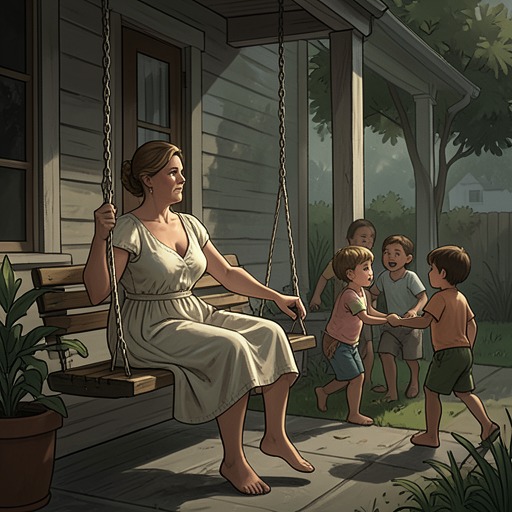
unnatural mother
The Lost DaughterThe expression unnatural mother crystallizes Leda’s conflicted understanding of herself as a parent. It is not presented as a simple verdict on whether she loves her daughters: the narrative sets acts of tenderness and vivid affection beside exhaustion, anger, and moments when Leda fails to respond as a mother is expected to. The phrase becomes explicit during her confrontation with Nina, but the contradictions it names have appeared throughout Leda’s memories of motherhood.
The Expression and Its Naming
The expression enters the story when Nina discovers that Leda has kept Elena’s doll. Nina reproaches Leda for having possessed the doll while Elena was crying and for watching without intervening. Leda answers by describing herself as an unnatural mother. Nina accepts the label, takes the doll back, and breaks off their relationship, saying that she wants nothing more from Leda. The phrase therefore arises not as an abstract reflection but in a specific conflict over who noticed a child’s distress and who acted—or did not act.
Leda’s self-description also carries a sharp irony. At the moment she names herself, she offers Nina the keys to her apartment and says she will be leaving that night, so the apartment will be empty until the end of the month. The label does not resolve the dispute or restore trust. Instead, it arrives alongside a practical offer that may help Nina and a departure that leaves their rupture intact.
Motherhood as Attachment and Strain
Leda’s account of pregnancy gives the expression a history in bodily ambivalence. She remembers the pregnancies as experiences in which a life that was hers seemed to move away from her even as it grew within her. Bianca was born when Leda was twenty-three; she planned to have Marta soon afterward, believing that Bianca needed a sibling. By twenty-five, Leda felt that other possibilities in her life had closed, while Gianni traveled from one opportunity to another and gave little attention to the girls. Her account resists a neat opposition between wanting children and resenting motherhood: desire, family expectation, bodily change, and a sense of lost freedom coexist.
The daily work of caring for the girls sharpened that conflict. When Marta would not sleep at night and Bianca demanded Leda’s attention, Leda tried to remain patient and to be a good mother. She let Bianca play at caring for her beneath the kitchen table, even when fatigue made her fall asleep during the game. But when Marta began to cry in another room, Leda would abruptly leave Bianca to tend to her younger daughter. She remembers feeling almost relieved to have a reason to stop the game, while also telling herself that Marta, rather than Leda, was pulling her away. The memory joins real caregiving to self-justification and guilt.
A related tension appears in Leda’s memories of her own mother. As a child, Leda wanted to comb, wash, and dress her mother as if she were a doll, but her mother resisted those games. Leda later tried to give Bianca the patient, accepting play she herself had wanted: she became Bianca’s doll and let her daughter pretend to care for her. Yet when Leda’s own mother pulled her from the sea as a child, she could not tell whether the forceful care came from worry or long-held anger. Across generations, care appears as necessary and intimate, but not free of impatience, resistance, or unresolved feeling.
Failures of Attention and Control
Leda’s memories do not limit maternal conflict to inward frustration. While working on an essay in the kitchen, she was distracted by her stalled research and anxiety about whether a professor would help publish it. When five-year-old Bianca struck her ear, Leda responded by striking Bianca repeatedly, insisting that the child must not hit her. She remembers the episode as more than a lesson about manners: she recognizes that the blows were real violence, even though they were controlled and not hard. She then took Bianca into the hall and closed the door, telling her to leave because Leda had to work. The remembered scene makes the expression’s moral weight concrete: it concerns harm and rejection as well as the pressures that help explain how Leda reached that moment.
Other scenes show a less overt but still consequential failure to meet a child’s needs. In the confrontation with Nina, Leda’s silence while Elena cried becomes the central accusation. Leda does not contest Nina’s account; she accepts the description Nina gives her. The doll makes the disagreement more charged, since it had belonged to Elena and Leda had kept it. In this encounter, maternal responsibility is measured through attention and response, not simply through feeling.
Love, Memory, and the Limits of the Label
Leda’s memories of Bianca and Marta complicate any reading of unnatural mother as proof that affection was absent. She recalls taking three-year-old Bianca sledding in a pink snowsuit and remembers their shared excitement as they called to go again. She also remembers Marta watching for her return from work, then running down the stairs to throw herself into Leda’s arms. Those recollections are physical and specific: the daughters’ small bodies, their eagerness to touch and embrace, and Leda’s own arms remain present in memory even as the girls grow older.
The expression thus holds together facts that resist a single judgment. Leda has cared for her daughters, cherished particular forms of closeness, and remembered their childhood with longing. She has also felt motherhood as constricting, excused her withdrawal from Bianca, struck her, and failed to intervene when Elena was distressed. Calling herself an unnatural mother makes that contradiction speakable, but does not settle it. The phrase marks the distance between an ideal of maternal responsiveness and Leda’s lived conduct, while the narrative’s competing memories prevent either love or failure from becoming the whole account.